
Current treatments for Hurler syndrome – an overview
Hurler syndrome (severe mucopolysaccharidosis type I, MPS I-H) is now a treatable condition. The main established therapies are haematopoietic stem cell transplantation (HSCT) and enzyme replacement therapy (ERT) with laronidase, supported by intensive multidisciplinary care. For most children with severe MPS I-H, HSCT remains the standard of care to preserve brain function, while ERT and specialist surgeries address many of the remaining physical problems.
This page summarises the current standard treatments, who they are for, what they can and cannot do, and how they are combined in real life.
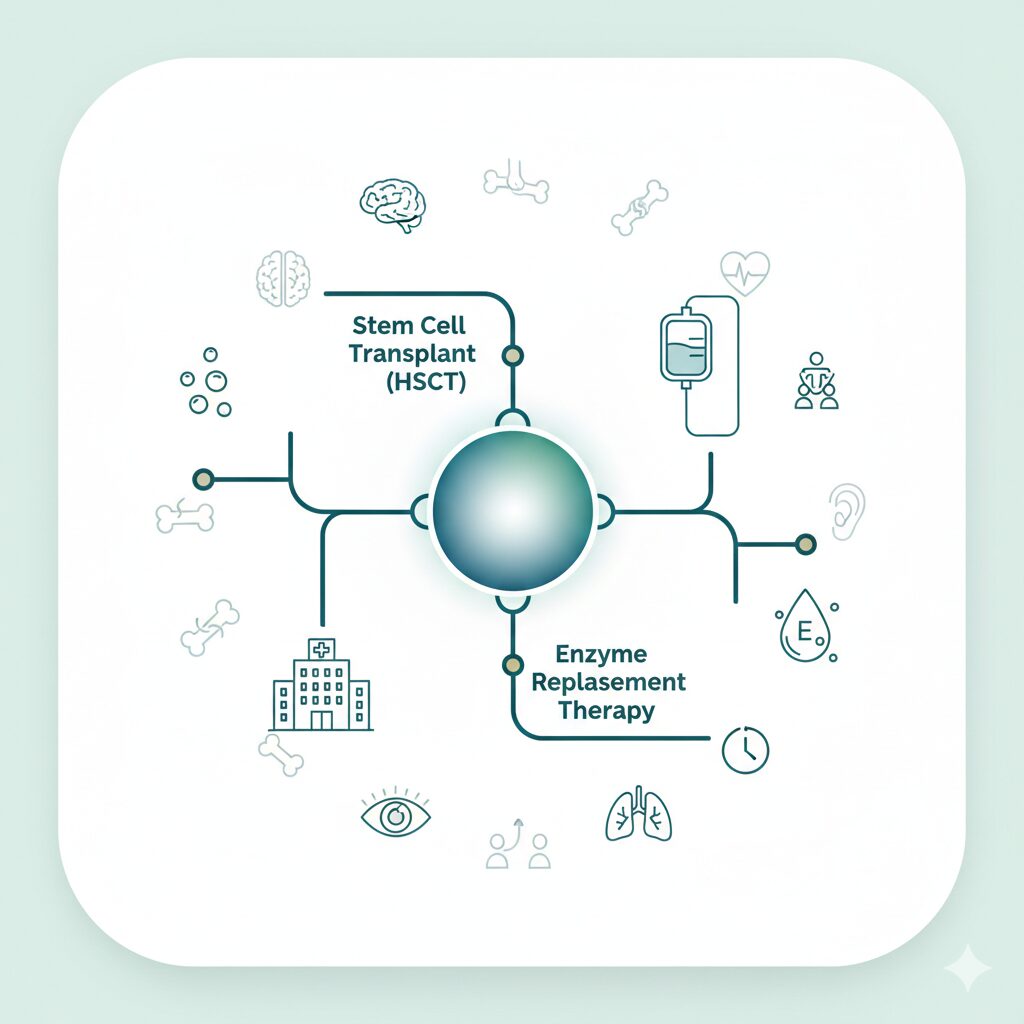
The three pillars of current treatment
Today’s management of Hurler syndrome is built around three main pillars:
Haematopoietic stem cell transplantation (HSCT)
One-off intensive treatment aiming to provide a lifelong source of enzyme-producing cells.
Best at protecting the brain and nervous system when performed early.
Enzyme replacement therapy (ERT) with laronidase
Regular intravenous infusions that help many body organs and tissues.
Does not adequately treat the brain, so not sufficient on its own for most children with severe MPS I-H.
Multidisciplinary supportive care
Ongoing management of the heart, lungs, skeleton, hearing, vision, teeth and development, regardless of HSCT or ERT status.
Haematopoietic stem cell transplantation (HSCT)
HSCT replaces a child's bone marrow with healthy donor stem cells that can make the missing enzyme, alpha L iduronidase (IDUA). Donor cells migrate to many organs and into the brain, where they release enzyme that can be taken up by surrounding cells.
Who HSCT is usually for:
- ✓Children diagnosed with severe MPS I-H
- ✓Typically under 2–2.5 years of age at the time of transplant
- ✓With enough heart, lung and general health reserve to safely undergo conditioning
Goals of HSCT:
- ✓Preserve or stabilise neurocognitive function as much as possible
- ✓Improve survival into adolescence and adulthood
- ✓Reduce or stabilise many somatic features
Realistic expectations:
- !HSCT is not a cure and many children still experience skeletal, eye and hearing issues
- !HSCT carries short-term risks and requires prolonged hospital care
HSCT Process
Enzyme replacement therapy (ERT) with laronidase
ERT uses a manufactured form of IDUA, given as a weekly intravenous infusion. The enzyme travels in the bloodstream and is taken up by many cells, helping them break down stored glycosaminoglycans (GAGs).
Who usually receives ERT:
• Children with severe MPS I-H as a bridge to HSCT, to improve clinical status before transplant.
• Children, young people and adults with attenuated MPS I, for whom HSCT is not recommended.
• Patients with severe MPS I-H who are not candidates for HSCT due to age, organ function or other factors.
Benefits ERT can offer:
- Reduction in liver and spleen size
- Improvement or stabilisation of respiratory function and exercise tolerance in many patients
- Help with fatigue, endurance and general wellbeing in some individuals
Key limitations
• Laronidase does not adequately cross the blood–brain barrier, so it cannot reliably prevent neurocognitive decline in severe MPS I-H on its own.
• Weekly infusions are time-consuming and require long-term venous access or repeated cannulation.
• Some patients form antibodies that may reduce effectiveness or cause infusion reactions; these are usually manageable but need monitoring.
How HSCT and ERT work together
In modern care, HSCT and ERT are often used together rather than as either/or options for severe MPS I-H. A common approach is:
Typical path in severe MPS I-H
Why this combination makes sense:
- ✓HSCT targets brain and long-term systemic enzyme supply
- ✓ERT helps stabilise the child while waiting for transplant and supports slower-responding organs
- ✓In some centres, ERT may be restarted later if graft failure or ongoing disease occurs
Operations and supportive treatments that are part of standard care
Even with HSCT and/or ERT, most children with Hurler syndrome will need multiple other treatments:
ENT & airway procedures
• Grommet insertion for glue ear
• Adenotonsillectomy for airway obstruction and sleep apnoea
• Careful airway assessment before any anaesthetic
Orthopaedic surgeries
• Hip reconstruction for dysplasia
• Spinal fusion for severe kyphosis or scoliosis
• Correction of limb deformities (e.g. genu valgum)
Cardiac surgery
• Valve repair or replacement if valve disease becomes severe
Carpal tunnel release
• To relieve median nerve compression in older children
Physiotherapy & occupational therapy
• To maintain mobility and independence
Additional support
• Pain management
• Specialist dental care
• Orthoses and splints
What current treatments do well
• Change the outlook from very early death to survival into adolescence and adulthood for many children with Hurler syndrome
• Protect neurocognitive function when HSCT is done early
• Improve or stabilise visceral organ involvement (liver, spleen, many respiratory and cardiac features)
• Reduce hospitalisations for some complications compared with untreated natural history
Orthopaedic surgeries
• Complete prevention of skeletal disease – kyphosis, hip dysplasia and joint problems remain common
• Full normalisation of growth and physical appearance
• Elimination of hearing and vision problems – many still need aids, glasses or surgery
• Removal of the need for recurrent operations, sometimes throughout childhood and adolescence
How treatment decisions are made today
Treatment decisions are made by a specialist team, usually including metabolic physicians, transplant doctors, cardiologists, anaesthetists, orthopaedic surgeons and others. They consider:
- Whether the child’s MPS I is severe (Hurler) or attenuated
- The child’s age and neurodevelopment at diagnosis
- Current heart, lung and other organ status
- Donor availability and transplant centre experience
- Family values, preferences and practical circumstances
For families
You should be given time and space to ask questions, receive written information, and consider a second opinion if you wish.
Key questions to ask:
• What are the risks and benefits for my child?
• What is the timeline for treatment?
• What support is available during recovery?
• What are the long-term expectations?
• Are there clinical trials available?
How current treatments fit with future options
New therapies such as gene therapy and novel enzyme approaches are being designed on top of, not instead of, current standards. For many children, participation in future clinical trials will still assume a background of:
- Early HSCT where appropriate
- Optimised ERT schedules in attenuated or non-transplant patients
- Good multidisciplinary support and monitoring
Families considering research options will always need to discuss how any study relates to the current standard of care and whether it adds to or replaces parts of that care.
Key facts about Hurler syndrome
- Today's core treatments for Hurler syndrome are HSCT, ERT with laronidase and multidisciplinary supportive care.
- For most children with severe MPS I-H, early HSCT remains the standard of care for protecting brain function, usually combined with ERT before transplant.
- ERT is essential for many patients with attenuated MPS I and those who cannot undergo HSCT, and it supports organ function even in severe cases.
- Even with the best current treatments, many children will still experience skeletal, eye, hearing and joint issues and need long-term surgeries and therapies.
- New therapies are emerging, but they currently build on existing treatment strategies rather than fully replacing them.
HSCT for Hurler syndrome
How transplant works, timing and risks
Enzyme replacement therapy
Laronidase infusions, benefits and limitations
Multidisciplinary care
Cardiac, orthopaedic, respiratory, ENT and more
Emerging therapies and research
Gene therapy and new approaches